
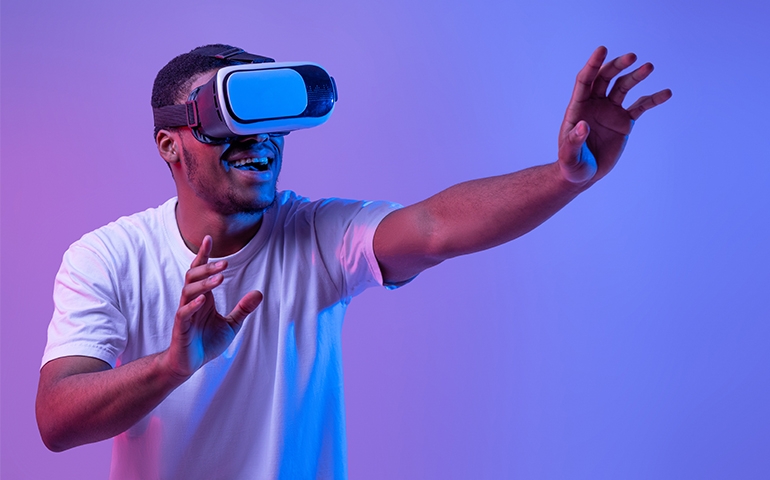
Ever dreamed of exploring different worlds from the comfort of your own home? All you need is a headset to make it a reality.
While the promise of a truly immersive virtual reality (VR) experience has been explored for decades, the idea had never quite reached its potential. However, the growing number of major tech companies such as Apple, Sony PlayStation and Meta investing heavily in VR has turned this unique form of entertainment into something mainstream.
For those of us who wear glasses or contact lenses regularly and want to enjoy a virtual reality experience like everyone else, here’s how to get the very most out of this technology.
What are virtual reality headsets?
To begin your adventure in the digital world or metaverse, you need equipment — known as virtual reality, or a VR headset. A VR headset is a device that straps around the head with a screen that covers the wearer’s field of vision.
Some of the more basic models are compatible with smartphones, while others offer a high-tech display that fully covers your eyes for a completely immersive 3D experience. These headsets use stereoscopic sound and image, along with gyroscopic sensors and accelerometers to coordinate orientation with the wearer’s physical position in the real world, synchronising the experience.
Can I use virtual reality with contact lenses?
Yes. If your eyes require vision correction, contact lenses are generally the best and most comfortable option when using a VR headset. When doing so, your prescription lenses should help you see clearly and comfortably as you explore the virtual world around you.
Benefits of wearing contact lenses with VR
Since contact lenses sit on the surface of the eye, they help you have a more immersive VR experience. Here are some other reasons why contact lenses tend to be the better choice when using a VR device:
- Contact lenses offer a wider range of peripheral vision than glasses
- VR games and experiences generally require agile movements that can cause glasses to fog up inside the headset
- Without bulky glasses frames, the VR headset will fit more comfortably on the wearer’s head
- Prescription glasses can scratch the inside of a VR headset or even break under pressure from the straps
- The brightness of a VR headset can reflect off prescription lenses, which doesn’t happen with contact lenses
Can I use virtual reality with glasses?
In most cases yes, though this will depend on the VR headset manufacturer. While many do cater for glasses wearers, not all do. There is therefore no guarantee that every headset will fit comfortably with glasses, particularly those with a very distinctive frame or a very large shape.
If you’re planning to buy your own VR headset and intend to use it with your glasses, try it out in a physical store first and check that you can use it comfortably during your VR experience.

What are prescription VR lenses?
As an alternative to contact lenses and glasses, some VR headsets allow prescription lens inserts or adapters to provide vision correction when in use. While they do solve the problem of bulky glasses frames interfering with your VR experience, these custom lenses can be quite costly and represent an additional expense on top of an already expensive device such as a VR headset.
Furthermore, given the changing nature of our vision over time, you’ll need to replace the prescription lenses periodically to ensure the best possible 3D experience. Another thing to bear in mind is that there are very few manufacturers of these specialist lenses, meaning your options are limited when it comes to swapping them between headsets.
While they do spare you the discomfort of wearing glasses, so too do contact lenses — which can be a more practical and budget-friendly option.
Are virtual reality headsets harmful to your eyes?
While there is no evidence that VR headsets cause long-term vision problems, they should be used with care. As with many digital devices, the time we spend looking at screens tends to reduce our normal blinking rate, which leads to eye strain and dry eyes — commonly known as digital eye strain.
‘Cyber sickness’ can also affect VR users, with symptoms such as dizziness, headaches and difficulty focusing. In some cases, VR users have also reported experiencing changes in depth perception and spatial awareness.
For contact lens wearers, the main concerns with excessive VR use are dry eyes and discomfort caused by disrupted blinking patterns. These side effects can be easily managed by keeping track of the time spent in the headset, practising the 20-20-20 rule, and taking breaks to rest and use contact lens-compatible lubricating eye drops.
If you notice any changes in your vision or eye pain, we recommend stopping use of your VR headset and contacting an eye care professional so they can assess the situation.
Do augmented reality contact lenses exist?
As depicted in science fiction films and popular TV series like Black Mirror, ‘smart’ or augmented reality contact lenses could become a reality in the coming years. Several tech companies are pioneering augmented reality built directly into a contact lens-like device.
Unlike virtual reality, these lenses will use the concept of augmented reality. This means digital information or visual elements will be displayed alongside or overlaid on our view of the physical world.
Using an AR (Augmented Reality) framework, you’ll be able to access information directly in your field of vision rather than having to look at your phone. Imagine being able to check the weather forecast, or get directions to the airport instantly in front of your eyes, all while still being able to see the world around you. Picking up your phone to read a message will be a thing of the past.
Order your contact lenses today for a clear view of the real world — or whatever other world you’d like to explore in the metaverse.