
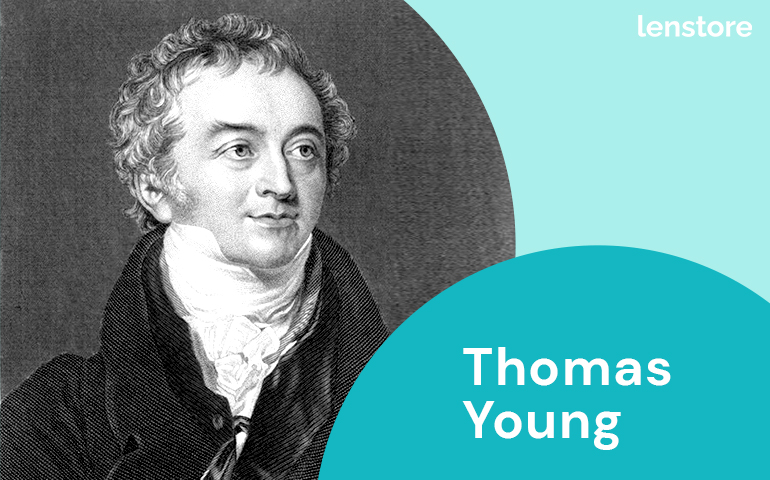
Thomas Young – (1773 – 1829)
Born in Somerset, England, in 1773, Thomas Young was a British scientist, physician and polymath whose extraordinary range of interests spanned everything from eye anatomy to Egyptology. By the age of 14, Young had already learned more than ten languages, including Greek, Latin, Arabic and French. His passion for biology and anatomy led him to study medicine at St Bartholomew’s Hospital in London in 1792. He went on to continue his studies at the University of Edinburgh and the University of Göttingen in Germany, where in 1796 he earned his doctorate in medicine.
In 1799, Thomas Young returned to London and established his own medical practice. Though a gifted physician, Young was easily drawn to his other scientific interests and was as much at home in the lecture hall and the laboratory as the clinic. His groundbreaking work on light waves brought him into the same scientific circles as Isaac Newton. In 1801, he was appointed Professor at the Royal Institution, where he delivered more than 90 lectures before resigning to return to his practice. Many of those lectures were published years later and are still used in courses today.
In 1811, Young was appointed physician to St George’s Hospital, yet continued his research beyond medicine into literature and ancient languages. Young played an important role in the decipherment of the Rosetta Stone — his early notes and hieroglyph diagrams made it possible for his rival Jean-François Champollion to complete the full translation in 1822.
His friends and academic circle held him in the highest regard, and his medical colleagues considered him a man of genuine intellectual passion and a true “man of science”.
Young died at the age of 55 at his home in London and was buried in the family vault at Farnborough, Kent. A memorial tablet in St Andrew’s Chapel in Westminster Abbey honours Young alongside other notable British scientists including Matthew Baillie and Nobel laureate John Strutt, 3rd Baron Rayleigh.
Thomas Young’s contributions to eye care
During his studies in medicine and anatomy, Thomas Young developed a deep interest in the sensitivity of the eye to light and refraction. Young observed that it was a change in the shape of the crystalline lens — not the cornea — that allowed the eye to see clearly at different distances. Considered a pioneer of physiological optics, here are some of his other discoveries and research into vision:
- Widely regarded as the first person to comprehensively describe and define astigmatism
- He proposed how the eye’s photoreceptor cones perceive colour wavelengths. This was later known as the Young–Helmholtz trichromatic theory — the idea that colour perception is based on three receptors in the eye sensitive to red, green and blue tones.
- He designed his own optometer to accurately determine the focus state of the eye, enabling better prescriptions for corrective contact lenses
- He delivered lectures to the Royal Society on topics including “The Mechanism of the Eye”, “The Theory of Light and Colours” and “Observations on Vision”, which detailed his discoveries in eye anatomy and how refraction and accommodation affect sight
Other notable achievements of Thomas Young
As a polymath with a vast knowledge of many subjects, Thomas Young’s achievements extended well beyond his primary profession as a physician. Young had a keen interest in languages and light. Here are some of his most notable accomplishments in those fields:
- Elected a Fellow of the Royal Society at the age of 21, he went on to become its Foreign Secretary — a post he held until his death in 1829
- Young proposed the wave theory of light, in opposition to Isaac Newton’s corpuscular (particle) theory
- He developed a measure now known as “Young’s modulus”, which helps quantify the elasticity of materials
- Young coined the term “Indo-European” to describe the family of major European languages. He also divided the world’s languages into five broad families: monosyllabic, Indo-European, Tatar, African and American.
- As an Egyptologist, Young made significant advances in the decipherment of hieroglyphics, which contributed to the eventual translation of the Rosetta Stone
- He was an early contributor to the Encyclopædia Britannica, writing biographies and articles on music, languages and science
- Young’s equation, named after him, describes the relationship between a liquid when it comes into contact with a solid surface and the energy created
- Elected an Honorary Foreign Member of the American Academy of Arts and Sciences in 1822
Final word
Young’s theories provided a springboard for the future research and discoveries of other visionary scientists. His contemporary, Sir John Herschel, who proposed some of the earliest contact lens designs, described Young as a “genuinely original genius”.
While Thomas Young did not invent any specific eye care device, his legacy to optometry lies in his pioneering work on how the eye perceives colour, and in being the first person to describe and propose treatments for astigmatism.