
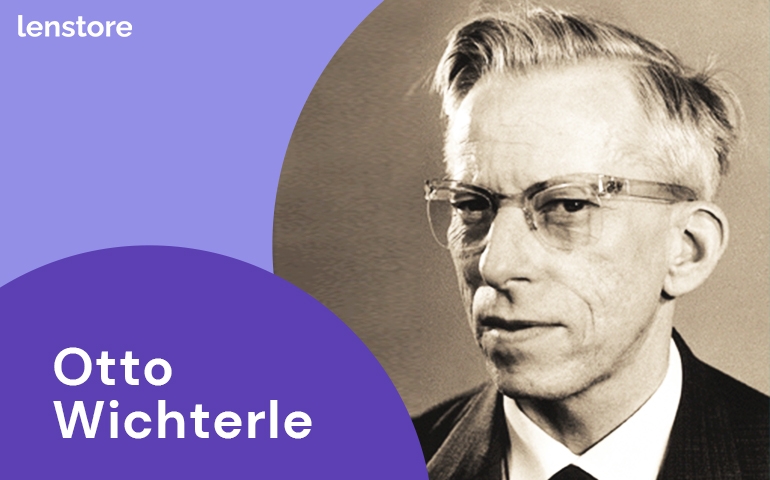
Otto Wichterle (1913 – 1998)
Otto Wichterle was an inventor and chemist born on 27 October 1913 in Prostějov, Moravia, in what was then Austro-Hungary (now the Czech Republic). Wichterle’s father was a celebrated engineer, but rather than follow in his footsteps, Otto chose chemistry as his professional ambition rather than mechanical engineering.
Wichterle studied at the Czech Technical University in Prague. He graduated in 1936 and earned two doctorates, the last of which was in chemistry, awarded in 1939. As a researcher, he specialised in plastic hydrogels, which proved to be of incalculable value in ophthalmology.
Throughout his career, his political beliefs brought him into conflict with the Czech communist government and the academic establishment, which repeatedly denied him funding for his experiments. This political obstacle led him to carry out much of his work at home, often with the help of his wife Lidia, a physicist.
Wichterle retired in 1979 but continued experimenting with other applications for polymers, travelling and working on computer programming. Following the Velvet Revolution of 1989, he returned to academic life as the elected president of the Czech Academy of Sciences. Otto Wichterle passed away in his sleep at the age of 84 on 18 August 1998 in Stražisko, Czech Republic, not far from the village where he was born.
Otto Wichterle’s contributions to eye care
Otto Wichterle’s impact on eye care and his advances in visual correction methods are closely tied to his chemical studies and experiments. His development of plastic materials and research into hydrogels were essential in the creation of soft contact lenses.
By developing a new material called pHEMA (polyhydroxyethyl methacrylate), with the help of his colleague Drahoslav Lím, this new compound made it possible for Wichterle to create soft contact lenses with a specific curvature that substantially improved wearing comfort. This transparent polymer material could absorb almost 40% water and be moulded into specific shapes to better fit the wearer’s eye. To develop a production method for his invention, Otto Wichterle used his son’s Merkur construction toy to mould the first hydrogel lens, which he named Geltakt.
Other notable achievements of Otto Wichterle
Wichterle won numerous awards throughout his career and received several honours, including:
- Holder of 200 patents
- Author of 180 publications in leading scientific journals
- First elected president of the Czech Academy of Sciences
- Asteroid 3899 (Wichterle), orbiting the sun, was named in his honour
- A Google Doodle celebrated the 108th anniversary of his birth on 27 October 2021
- Wichterle received honorary diplomas from two prestigious American universities: the Polytechnic University of Brooklyn and the University of Illinois
Final thoughts
Otto Wichterle is considered the inventor of the soft contact lenses we know today, built from hydrogel polymers — and the person behind their patent and mass commercialisation. Building on the moulding method first described by John Herschel, Wichterle’s advances made contact lenses accessible to the masses by patenting them and licensing the technology to companies such as Bausch & Lomb (though without Wichterle’s permission at first).
Wichterle and his protégé, Drahoslav Lím, knew there was scope for further advances and improvements to hydrogel lenses, and when Wichterle died in 1998, Lím continued expanding on the work his mentor had done during his lifetime.