
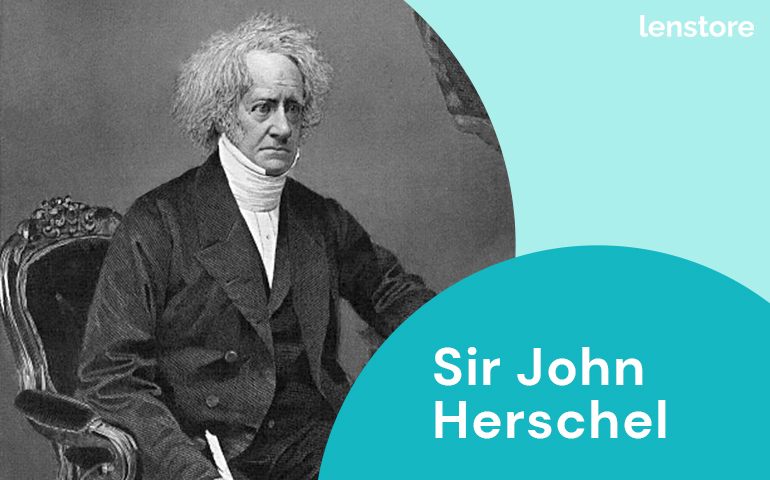
Sir John Herschel – (1792 – 1871)
Born in Slough, England, in 1792, John Frederick William Herschel was a British astronomer, scientist, mathematician, photographer and inventor. He was the only son of the celebrated astronomer William Herschel. He was educated at Eton College and later studied at the University of Cambridge, where he read mathematics alongside Charles Babbage, who is credited with inventing the digital computer.
After completing his studies at Cambridge, Herschel worked alongside his father in the field of astronomy, which in turn sparked his interest in optics and the use of large telescopes for observing the night sky. Through his use of these telescopes, he discovered and catalogued hundreds of nebulae and thousands of double stars, earning him the prestigious Gold Medal of the Royal Astronomical Society in 1826. The following year, he was elected President of the Society.
To catalogue the sky that was not visible from England, Herschel travelled to South Africa in 1834, where he was able to make astronomical observations of stars and cosmic events in the southern hemisphere. During the four years he spent in South Africa, Herschel completed extensive studies of the southern sky, creating the first comprehensive catalogue of the Earth’s skies.
On returning to England from South Africa, Herschel turned his scientific interests to chemistry and photography, in which he pioneered an imaging process called the cyanotype in 1842. Using iron oxidation, this newly invented method became widely used in architectural blueprints. Its popularity inspired other inventors such as Henry Fox Talbot and Anna Atkins to apply chemical processes to their explorations in the increasingly popular field of photography.
Later in life, Herschel moved outside London to pursue various experiments and continued writing papers that he shared with the scientific community, with his discoveries about stars and other celestial phenomena being particularly notable.
In 1871, he died at his home in Kent and was buried with full honours in Westminster Abbey in London. His tomb stands alongside those of other famous British scientists such as Isaac Newton and Charles Darwin, who was buried next to Herschel in 1882.
Sir John Herschel’s contributions to eye care
Combining his knowledge of lenses and the reflection of light, John Herschel proposed one of the world’s first contact lens designs in 1827, and documented further research into vision, including:
- Studies of various corneal irregularities and astigmatism
- Suggestions for grinding glass into a rounded lens that could sit on the surface of the cornea as closely as possible, along with a gel filling that could be placed between the eye and the lens
- Proposals for creating a physical mould of the eye to achieve a precise corneal fit using a ‘transparent medium’
- Research into the causes of colour blindness
Unfortunately, the technology needed to prototype Herschel’s lens model did not exist at the time. However, his theories provided a solid starting point for future research and advances by other visionaries in the field of contact lenses.
Other notable achievements of John Herschel
While John Herschel was a key figure in the early concept of contact lenses, his main scientific contributions centred on advances in astronomy, meteorology and photography. Here are some of his most notable achievements in those fields:
- He is credited as the first person to use the word ‘photography’ and to coin the terms ‘negative’, ‘positive’ and ‘snapshot’ to describe photographs
- He invented the cyanotype, also known as the blueprint process — a camera-less method that uses iron salt solutions, UVA light and water to create a static image through oxidation
- He built the first large-scale telescope in the southern hemisphere
- He officially named the four moons orbiting Uranus and the seven moons of Saturn
- He invented the actinometer, a device used to measure the power of solar radiation through the use of photons
Final thoughts
Although Herschel died before contact lenses were ever created, his studies in the field of optometry and his proposal for a lens based on a mould of the eye laid the groundwork for other important figures in eye care — such as F.A. Muller and Adolf Fick — to create the precursors to the contact lenses we all know today.