
Ophthalmologists and opticians recommend not wearing contact lenses while swimming – or even in the shower or bath.
Water can carry different types of pathogens and bacteria that can come into contact with your lenses and, in turn, your eyes. This can cause irritation and, in more serious cases, even vision loss.
Swimming with contact lenses
Swimming with contact lenses should be avoided wherever possible. It’s recommended not to wear lenses when in contact with any type of water – whether tap water, a swimming pool, or the sea. Even in chlorinated water, harmful bacteria and other organisms, such as Acanthamoeba, can survive.
The chemicals in a swimming pool can irritate the eyes, and soft contact lenses, which are porous, can absorb chemicals and trap bacteria, raising the risk of infection. Fresh water can also make soft lenses swell and stick to the eye, making them uncomfortable and difficult to remove. Although gas-permeable rigid lenses are more breathable, they can easily dislodge from the eye and should therefore never be worn in the pool.
If your vision doesn’t require much correction, the best option is to remove your daily, fortnightly, or monthly lenses before entering the water. Make sure to have a spare pair ready to use after your swim.
Prescription swimming goggles
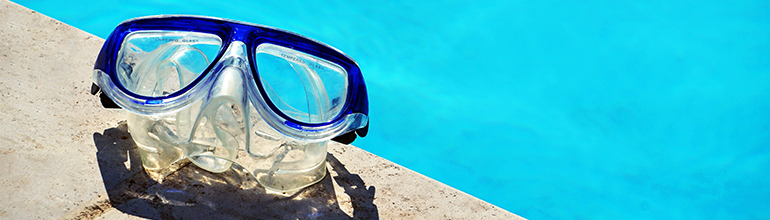
Prescription swimming goggles help with vision and protect your eyes from infection while you’re in the water, letting you enjoy a swim in the pool or a dip in the sea — handy if you’re travelling with contact lenses.
Water has a significantly different refractive index to air, and as a result our eyes struggle to see clearly underwater. Even people with perfect vision will experience blurry vision beneath the surface.
Swimming goggles can be bought ready-made with basic corrections or custom-made to match your exact prescription. Ready-made goggles come in a range of dioptric corrections and are a good option for most people.
However, if you have a more complex prescription, you may prefer custom goggles. Modern swimming goggles come with a wide range of features, including anti-fog coating, UV protection, and shatterproof lenses, and are widely available from opticians. Ask your optician for advice on the best solution for you.
At the beach or the pool with contact lenses
There are two main risks. First, your contact lenses are likely to fall out, leaving you with blurry vision. More importantly, you expose your eyes to the risk of infection.
If you do need to swim with contact lenses in, consider using daily disposable lenses and wear goggles over them for extra protection. Discard the daily lenses immediately after swimming, rinse your eyes with eye drops suitable for contact lens wearers, and put in a fresh pair. This helps limit the risk of your eyes being exposed to harmful bacteria that may have built up on your lenses while in the water.