
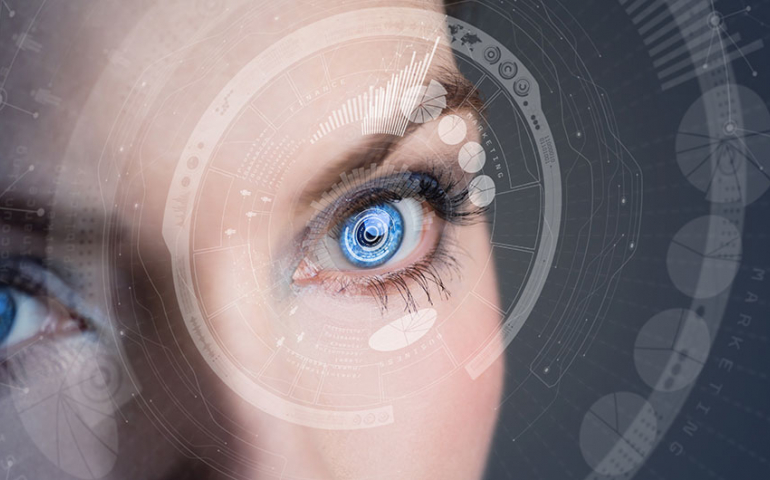
Imagine being able to check your phone with just a blink. Or having the weather forecast and the latest traffic updates displayed in real time on your eyelid. Sounds a little like science fiction, doesn’t it?
All of this could be possible with high-tech lenses. Drawing on new materials and technologies, these contact lenses go far beyond vision correction and serve as medical devices, health monitors, and even entertainment tools.
Our optometrist, Roshni, reveals everything about the latest and greatest in high-tech lenses. Prepare to be impressed.
Smart contact lenses
What are they?
Silicon Valley company Mojo Vision is the brain behind the world’s first smart contact lens, which uses augmented reality to display data and images directly in the user’s field of vision.
The “Mojo Lens” offers functions similar to those of a smartwatch, except it operates through eye movements. Although still a prototype, some of its capabilities are pretty mind-blowing. Weather alerts, traffic information, and health data can all be displayed via visual commands, and future features include wireless radio, image recognition, and a motion sensor. Pricing has yet to be announced.
What are the benefits?
The ultimate goal of the technology is to deliver useful, timely information without forcing you to look at your phone or lose awareness of the world around you. Imagine taking notes in meetings at the blink of an eye, or tracking your race progress without any digital device.
But these lenses aren’t just about giving people superpowers — they also help people with visual impairments, such as macular degeneration and glaucoma. The lenses will have the ability to magnify text, highlight the outlines of objects, and adjust lighting, helping people with limited vision to see the world around them more clearly.
Drug-releasing lenses
What are they?
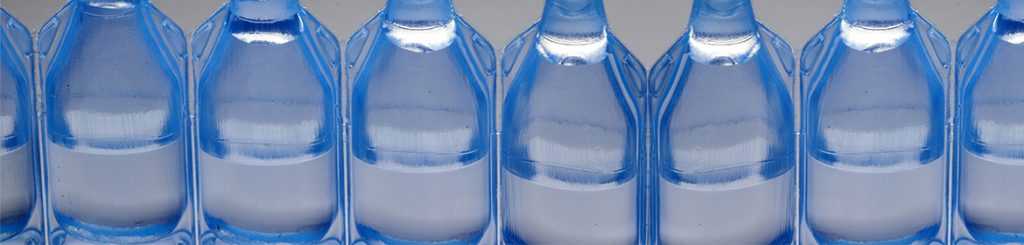
Drug-releasing contact lenses are designed for the gradual delivery of medication to the eye, offering an excellent alternative to daily eye drops, which can be unpleasant or tricky to apply correctly.
One development that has generated significant interest is Johnson & Johnson’s antihistamine-releasing lens. As the name suggests, the lens is enriched with the antihistamine ketotifen and aims to relieve the itching associated with allergies.
The lens has recently passed all three phases of clinical trials, so Johnson & Johnson will continue developing this new category of lenses.
What are the benefits?
If you’re one of the many millions of people who suffer from hay fever, you’ll understand why this development matters.
Currently, antihistamine eye drops are not compatible with contact lenses, which means many sufferers are forced to stop wearing lenses during allergy season. This is a real limitation for those who depend on their lenses for work, sport, socialising, and everyday life.
Antihistamine-releasing contact lenses could give lens wearers back some of their freedom and remove the need to switch to glasses.
These lenses will also have enormous benefits beyond allergies, giving people greater autonomy over their own health and reducing long-term pressure on healthcare services.
Colour vision lenses

What are they?
A new type of contact lens that can correct colour vision deficiencies in people who struggle to distinguish certain shades — typically red and green.
There is currently no cure for colour blindness, but engineers at Tel Aviv University have found a way to restore colour to the eye using light-filtering technology. This ultra-thin device, known as a meta-surface, is embedded into a standard contact lens to offer a safe and comfortable way to correct colour perception.
It has not yet completed clinical trials, but early results published by The Optical Society suggest the lens can restore colour and significantly improve the distinction of various shades.
What are the benefits?
While most people adapt to the challenges related to colour vision deficiency, it can make simple everyday tasks more difficult — such as reading traffic signals, taking the right medication, or even deciding whether a banana is ripe.
The condition can also cause learning difficulties and limit career choices. For example, some jobs — including electrician, pilot, and train driver — require precise colour recognition.
This new colour-correcting lens could help reduce these academic and professional barriers, and improve quality of life in sport, the arts, and the wider environment.
When will these high-tech lenses be available?
A great deal of research and development is still needed before these lenses are safe, comfortable, and consumer-ready — but it’s something to look forward to in the not-too-distant future.
Drug-releasing and colour vision lenses still have clinical trials to pass, but they’re a little closer to reaching the market. We’ll be watching with interest.
In the meantime, why not explore our range of contact lenses?