

Every contact lens, regardless of style or brand, has measurements that determine its size and shape. These are known as the base curve and diameter. On your prescription or lens box, the base curve is usually marked as BC or BOZR (back optic zone radius), and the diameter as DIA. These measurements are essential to ensuring your lenses fit your eye correctly for a comfortable wearing experience.
How to find your base curve and diameter
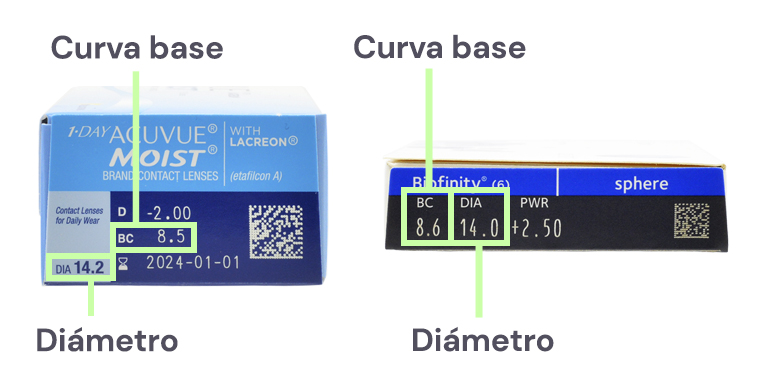
Base curve — labelled on the lens box as BC followed by the base curve value.
Diameter — labelled on the lens box as DIA followed by the diameter value.
What does the base curve number mean?
The base curve is a numerical measure of how curved your lens is. It is an important figure — typically between 8.3 and 9 millimetres for soft lenses — as it determines how well a lens will conform to the curvature of your eye’s surface. If the value is not right for your cornea, even a small difference of a few tenths of a millimetre can cause discomfort and poor vision.
The higher the base curve number, the flatter the lens. This means someone with a less curved cornea would need a lens with a higher base curve number.
What does the diameter number mean?
As in geometry, the diameter is the measurement from one edge of the lens to the other. It is measured in millimetres and typically ranges from 13.80 to 14.50mm, with 14.00mm and 14.20mm being the most common values in commercial soft lenses. The lens diameter is crucial to lens performance because it ensures the lens is neither too loose nor too tight, and that it covers the correct area of your eye.
Which base curve or diameter should I choose?
Our Head Optician at Lenstore, Roshni Patel, recommends using only the exact prescription issued by an eye care professional. Even a fractional difference in base curve or diameter can affect how well a lens fits your eye. If you end up wearing a poorly fitting lens, it can affect your eye health — for example, causing blurred vision. Fortunately, the most popular contact lens types are only manufactured with a limited range of base curves and diameters, so there is less margin for error when entering your prescription details.
Every eye is different, so what works for one person may not suit another. If you are not happy with the comfort of your lenses, we recommend speaking to your optician about trying a different lens type.
Can I order lenses with different base curves?
When you order contact lenses, the base curve values should always match. In exceptional circumstances, an optician might prescribe a different base curve for each eye, but this is relatively uncommon. When you order at Lenstore, we will alert you if you have entered a prescription with mismatched base curves so you can check that you have provided the correct details.
Can I order lenses with different diameters?
Most lenses are manufactured with a set diameter to limit the number of variations a manufacturer needs to produce. The diameter value is generally auto-filled when you enter your prescription details, making it impossible to select different diameters. One of the few occasions where you might use lenses with different diameters is if your optician specifically prescribes a different lens type (or a different brand) for each eye.
Do I need the same base curve if I switch lenses?
If you are thinking about switching lens type (for example, to coloured contact lenses), the eye care professional prescribing them should fit them first. Your optician will ensure the base curve is right for you, even if all the other prescription details match your new lens.
There are several factors your optician will need to consider and discuss with you before deciding whether a lens is suitable: the lens material, wearing schedule, and any care the lenses may require, among others.
For example, coloured lenses typically have a fixed aperture through which you see. This measurement is not the same as the base curve. If the aperture is larger or smaller than your pupil size, your vision will be blurred. Your optician will check that the lenses fit you in terms of both base curve and aperture before prescribing them.