
Soft contact lenses have come a long way in terms of technology and materials. Today, they’re made from both hydrogel and silicone hydrogel. But what’s the difference? And is one material better than the other?
What are soft contact lenses?
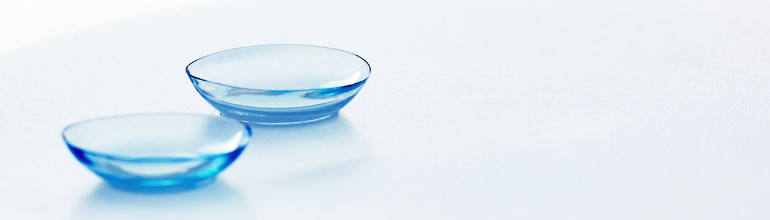
Contact lenses are classified as either “rigid” or “soft” depending on their elasticity. In simple terms, elasticity describes a material’s ability to hold its shape. Although rigid lenses have a longer lifespan, soft lenses are generally the more popular choice for several reasons.
As the name suggests, soft contact lenses are flexible and permeable, and they offer greater comfort than rigid lenses. There are two types: hydrogel and silicone hydrogel. Both have their advantages, and each offers something different.
Here’s how they compare in terms of comfort and eye health.
Hydrogel contact lenses
Introduced in the late 1950s, water-loving hydrogel lenses were among the first lenses made from soft materials rather than hard plastic. The gel-like consistency of the lens moulds to the shape of the eye, improving comfort and ease of use.
Anyone who has worn hydrogel lenses will know that they feel rigid when dry, but return to their soft, flexible state when hydrated. They have a natural water content that allows oxygen to pass through the lens, helping to keep eyes white and healthy. This characteristic makes them ideal for dry and sensitive eyes.
Despite the material’s moisturising properties, hydrogel lenses can gradually lose water during wear, causing end-of-day dryness. They also tend to attract more deposit build-up, which can cause discomfort.
Cleaning and rinsing reusable lenses, and replacing them on schedule, can help keep deposits under control. You could also opt for a more frequent replacement model, such as daily disposables.
Advantages
- Naturally compatible with the human eye
- Suitable for dry and sensitive eyes
- Slightly lower price
Considerations
- Low oxygen permeability
- Attract more deposits
- May experience end-of-day dryness
Silicone hydrogel contact lenses
Silicone hydrogel lenses are an advanced type of soft contact lens, combining enhanced oxygen permeability with a water content designed to deliver optimal comfort and healthy eyes.
The most significant advantage of silicone hydrogel contact lenses is that they can allow up to five times more oxygen to reach the cornea compared to standard hydrogel lenses. Without a healthy supply of oxygen, you may experience dry, itchy eyes and blurred vision — a condition known as hypoxia. The higher oxygen transmissibility of silicone hydrogel lenses helps keep eyes healthy and comfortable for longer, making them suitable for extended wear.
Silicone hydrogel lenses are also slightly more stable than hydrogel lenses, making them easy to handle while remaining comfortable for the eye. However, adding silicone to the hydrogel material can increase lipid deposit build-up and reduce the number of water molecules in the lens. Many manufacturers have introduced a wetting agent to address this and keep the lens hydrated for longer.
Some of the latest lens technologies transmit oxygen so efficiently that less silicone is required. This is important because it allows more room in the lens design for the water-loving materials that keep eyes hydrated.
Advantages
- Increased oxygen permeability
- Effortless handling
- Some lenses can be worn continuously for up to 30 nights (consult your optician first)
Considerations
- May attract more lipid deposits
- May not be suitable for sensitive eyes
- Slightly higher price
So, which is better — hydrogel or silicone hydrogel?
Neither material is better or worse; it simply comes down to comparing your options with your optician and finding the one that suits you and your lifestyle best. Both are available in a wide range of materials, prescriptions, and designs to suit most visual needs. Browse our full range of lenses here.