
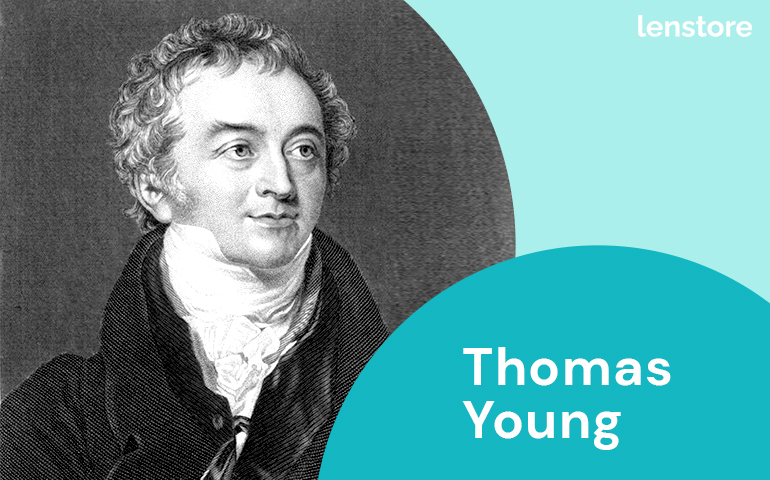
Thomas Young (1773 – 1829)
Born in Somerset, England, in 1773, Thomas Young was a British scientist, physician and polymath whose extraordinary range of interests spanned everything from eye anatomy to Egyptology. By the age of 14, Young had already learned more than ten languages, including Greek, Latin, Arabic and French. His passion for biology and anatomy led him to study medicine at St Bartholomew’s Hospital in London in 1792. He went on to continue his studies at the University of Edinburgh and the University of Göttingen in Germany, where in 1796 he earned his doctorate in medicine.
In 1799, Thomas Young returned to London and established his own medical practice. Though a gifted physician, Young was easily drawn to his other scientific interests and was as much at home in the lecture hall and the laboratory as the clinic. His groundbreaking work on light put him at odds with the ideas of Sir Isaac Newton, whose particle theory of light had dominated science for a century. In 1801, he was appointed Professor of Natural Philosophy at the Royal Institution, where he delivered more than 90 lectures before resigning to return to his practice. The lectures were later published as a book, A Course of Lectures on Natural Philosophy.
In 1811, Young was appointed physician to St George’s Hospital, yet continued his research beyond medicine into literature and ancient languages. Young made important early progress in deciphering the Rosetta Stone, identifying the meaning of several hieroglyphs, before his rival Jean-François Champollion completed the decipherment in 1822.
His friends and academic circle held him in the highest regard, and his medical colleagues considered him a man of genuine intellectual passion and a true “man of science”.
Young died at the age of 55 at his home in London and was buried in the family vault at Farnborough, Kent. A memorial tablet in Westminster Abbey honours his achievements.
Thomas Young’s contributions to eye care
During his studies in medicine and anatomy, Thomas Young developed a deep interest in how the eye focuses light. He showed that it was a change in the shape of the crystalline lens – not the cornea – that allows the eye to see clearly at different distances, a process called accommodation. (As we age, the lens stiffens and this ability fades, which is what causes presbyopia.) Considered a pioneer of physiological optics, here are some of his other discoveries and research into vision:
- Widely regarded as the first person to describe and measure astigmatism, which he identified in his own eyes
- He proposed that colour vision depends on three types of receptor in the eye, each sensitive to a different part of the light spectrum. Later developed by Hermann von Helmholtz, this became known as the Young–Helmholtz trichromatic theory – and we now know these receptors are the cone cells in the retina
- He designed his own optometer to measure how the eye focuses – a forerunner of the instruments used today to work out your prescription
- He presented papers and lectures to the Royal Society, including “Observations on Vision”, “On the Mechanism of the Eye” and “On the Theory of Light and Colours”, which detailed his discoveries about eye anatomy, refraction and accommodation
Other notable achievements of Thomas Young
As a polymath with a vast knowledge of many subjects, Thomas Young’s achievements extended well beyond his primary profession as a physician. Young had a keen interest in languages and light. Here are some of his most notable accomplishments in those fields:
- Elected a Fellow of the Royal Society at the age of 21, he went on to become its Foreign Secretary – a post he held until his death in 1829
- Young revived the wave theory of light, in opposition to Isaac Newton’s corpuscular (particle) theory, and demonstrated it with his famous double-slit experiment
- He developed a measure now known as “Young’s modulus”, which helps quantify the elasticity of materials
- Young coined the term “Indo-European” to describe the family of major European and Asian languages. He also divided the world’s languages into five broad families: monosyllabic, Indo-European, Tatar, African and American
- As an Egyptologist, Young made significant advances in deciphering hieroglyphics, which contributed to the eventual translation of the Rosetta Stone
- He was an early contributor to the Encyclopædia Britannica, writing biographies and articles on music, languages and science
- Young’s equation, named after him, describes how a drop of liquid spreads on a solid surface, based on the forces between the liquid, the solid and the surrounding air
- Elected a Foreign Honorary Member of the American Academy of Arts and Sciences in 1822
Final word
Young’s theories provided a springboard for the research and discoveries of other visionary scientists. His contemporary, Sir John Herschel, who proposed some of the earliest ideas for contact lenses, described Young as a “genuinely original genius”.
While Thomas Young did not invent any specific eye care device, his legacy to optometry lies in his pioneering work on how the eye focuses and perceives colour, and in being the first person to describe astigmatism. Just a few years later, in 1825, the astronomer George Airy designed the first cylindrical spectacle lens to correct it. Today, toric contact lenses – including daily disposable options – correct astigmatism comfortably, and are part of our full range of contact lenses. Your optometrist can check for astigmatism during a regular eye examination.