
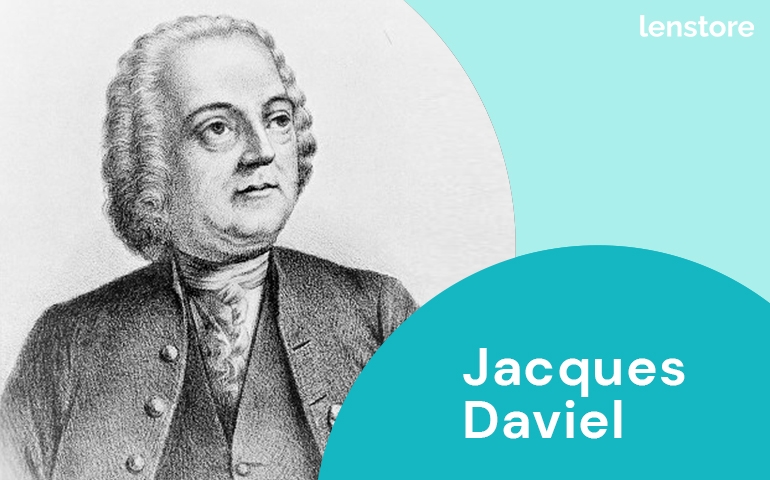
Jacques Daviel (1693 – 1762)
Jacques Daviel was an ophthalmologist and surgeon born on 11 August 1693 in La Barre-en-Ouche, France. His path into medicine began in Rouen, where he apprenticed under his uncle to start his surgical studies. Daviel then moved to Paris, where he joined the Hôtel-Dieu hospital to complete his education. Early in his career, Daviel volunteered as a surgeon to help patients suffering from the plague in Marseille, and in recognition of his work he was given a senior surgical post in the city.
From 1728, Daviel focused on ophthalmology, and in 1749 he was appointed oculist to King Louis XV. Daviel dedicated the rest of his career to eye care and to developing a new way of operating on cataracts. He suffered a stroke in early 1762 and died later that year, on 30 September, in Geneva, Switzerland.
Jacques Daviel’s contributions to eye care
Jacques Daviel had a profound impact on eye care throughout his lifetime. As early as 1728, he decided to dedicate himself entirely to eye diseases and to focus much of his research on cataracts. He took the opportunity available at the time to practise cataract surgery on cadavers.
However, it was by chance that Daviel made his most significant discovery. For centuries, the standard treatment for cataracts was ‘couching’ – using a needle to push the clouded crystalline lens out of the line of sight, where it sat at the back of the eye. During one operation in the 1740s, the lens could not be displaced in this way, so Daviel removed it from the eye altogether. To his surprise, the patient’s vision improved.
Daviel then devoted his energy to perfecting this method of extracting the lens to treat cataracts. His efforts culminated in 1752, when he presented a paper detailing his surgical technique to the Royal Academy of Surgery in Paris. Entitled ‘A New Method of Curing Cataracts by Extracting the Crystalline Lens’, it revolutionised the way cataracts were treated.
From Daviel to modern cataract surgery
Daviel’s idea of removing the clouded lens is still the basis of cataract surgery today. Modern operations use tiny incisions and ultrasound to break up the lens, which is then replaced with a clear artificial lens implant – usually as a quick day procedure. Many people still need glasses or contact lenses for some distances afterwards, especially for reading, as the eye loses its ability to change focus with presbyopia. Once your eye has healed and your optometrist has checked your new prescription, options such as multifocal lenses or daily disposables can help. Regular eye examinations are the best way to spot a cataract early, and here are some simple ways to protect your eyes as you age.
Other notable achievements of Jacques Daviel
Beyond his pioneering research into cataract surgery, Jacques Daviel was recognised with the following honours during and after his career:
- Awarded the Cross of Saint Roch by Louis XV
- Associate member of the Paris Academy of Surgery
- Elected foreign member of the Royal Swedish Academy of Sciences
- Since 1894, the Rue Daviel in the Butte-aux-Cailles district of Paris has been named in his honour
- The Hôtel Daviel in Marseille also pays tribute to this great figure of science and medicine
- A sculpted portrait in the courtyard of the Hôtel-Dieu hospital in Marseille commemorates the celebrated oculist
- The Jacques Daviel secondary school in La Barre-en-Ouche bears his name in tribute to the former oculist to the King of France
- A stone statue also honours him in Bernay
- A French postage stamp bearing his portrait, engraved by Albert Decaris, was issued in his memory
Final thoughts
Daviel laid the foundations for other celebrated eye care experts, such as José Ignacio Barraquer, to continue improving the quality of vision and life for people with cataracts and other eye conditions.