
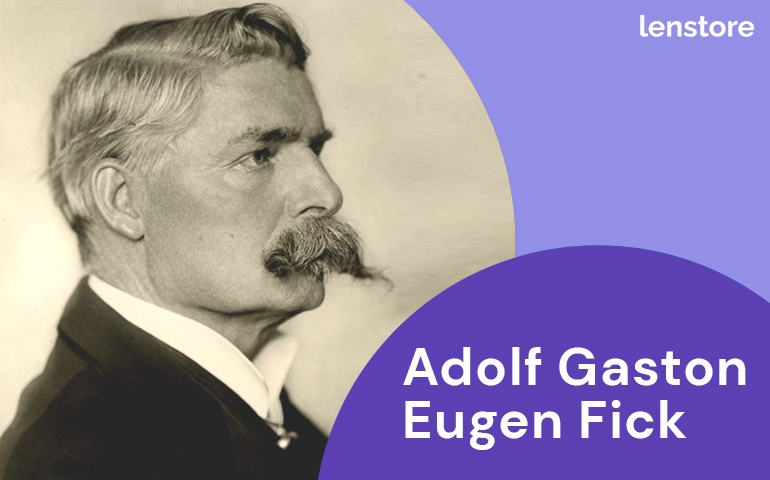
Adolf Gaston Eugen Fick (1852 – 1937)
Adolf Gaston Eugen Fick was an ophthalmologist who played a crucial role in the development of contact lenses. Born in Marburg, Germany, in 1852, Fick had an unfortunate start in life, losing both of his parents when he was young. He was raised by his uncle – who shared his name, Adolf Eugen Fick – a respected physician and physiologist of the time, best known for Fick’s laws of diffusion and for describing a method of measuring how much blood the heart pumps.
Under his uncle’s guidance, Adolf Fick (the nephew) chose to study medicine in Germany and Switzerland, obtaining his doctorate in 1875. Fick then emigrated to South Africa, where he opened and worked in a medical practice for several years. Longing for home, he returned to Europe and married Marie Wislicenus, daughter of the well-known chemist Johannes Wislicenus. The couple settled in Switzerland, where Fick worked as a physician and lecturer at the University of Zurich.
During the First World War, Fick worked as a doctor while continuing to advance his studies in ophthalmology and vision. Adolf Gaston Eugen Fick died in 1937 at the age of 84.
Adolf Fick’s contributions to eye care
- In 1888, Adolf Fick created a scleral lens – a shell-shaped lens made of blown glass – designed to correct refractive errors and an irregular cornea
- Because it rested on the sclera, the less sensitive white of the eye surrounding the cornea, the lens could be tolerated for short periods. Fick tested his design first on rabbits, then on himself, and finally on a group of willing volunteers
- Fick published his findings under the title ‘Eine Contactbrille’ (‘A contact spectacle’) in a well-known ophthalmology journal, describing one of the first clinical uses of contact lenses
Fick wasn’t the first to imagine a lens that sat on the eye – Sir John Herschel had suggested the idea decades earlier – and others, including Eugen Kalt in Paris and August Müller in Germany, were working on similar glass lenses around the same time.
Final thoughts
Adolf Gaston Eugen Fick is widely considered one of the inventors of the first true contact lenses. Although they were impractical to wear for more than a few hours due to their weight and size, Fick’s work inspired other innovators to make further advances in contact lens design – most notably William Feinbloom, who in the 1930s created lighter, more comfortable lenses using a hybrid of glass and plastic.
The biggest leap came in the 1960s, when Otto Wichterle and Drahoslav Lím developed the soft hydrogel lens. Today, the heavy glass shells of Fick’s day have given way to soft, breathable materials – see our guide to hydrogel vs silicone hydrogel – and comfortable daily disposable lenses that can correct short-sightedness, long-sightedness and even astigmatism. Curious what comes next? Take a look at the contact lenses of the future.